
Our Technology Stack | Costa Mesa, CA
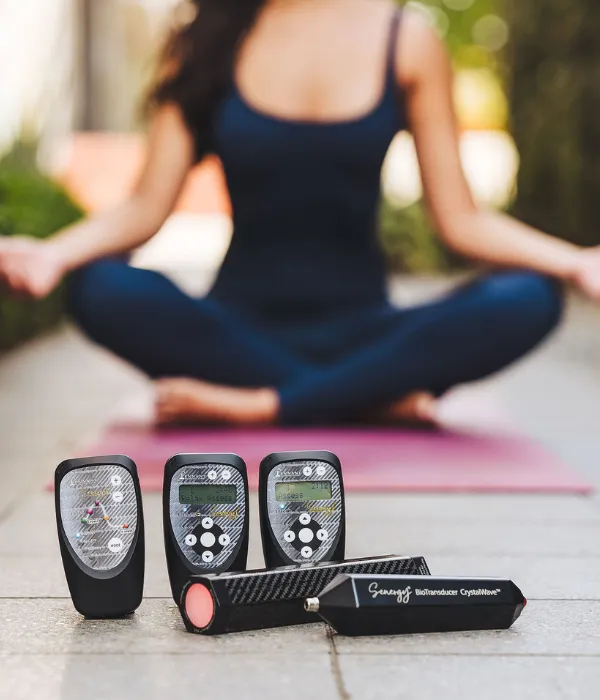
The Senergy BioModulator + BioTransducer
The Senergy BioModulator is an FDA-accepted microcurrent device that delivers biofeedback-modulated electrical impulses through the skin. Paired with the BioTransducer, it transmits frequencies that engage the peripheral nervous system to support pain relief, cellular voltage restoration, and the body's own repair signaling.
How It Works
The body conducts. The BioModulator listens, then responds.
Every cell in the body holds an electrical charge. Healthy voltage is tissue specific with every type of cell having an optimum membrane voltage. Injured, inflamed, or chronically stressed tissue drops well below that healthy range, which slows repair. The BioModulator is built on this bioelectric medicine framework. Made popular by the work of Dr. Jerry Tennant, author of the landmark work Healing is Voltage, Tennant established cellular voltage as a foundational principle of health, a framework that has since driven significant advancement throughout the field of bioelectric and regenerative medicine.
The device sends a low-level microcurrent into the body and reads the skin's electrical response in real time. As tissue impedance shifts, the waveform shifts with it. This is biofeedback-modulated stimulation: no fixed setting, no overdriving the system. The BioTransducer extends that signal using a combination of PEMF, scalar wave, and photobiomodulation technology, transmitting frequencies through clothing, casts, and footwear to reach deeper or less accessible treatment sites without requiring direct skin contact.
Clinical observation has shown that direct skin contact with the BioModulator produces up to a 300% change in tissue response. The BioTransducer, with no direct contact, has demonstrated 150% tissue change — a clinically meaningful result for a completely non-contact application.
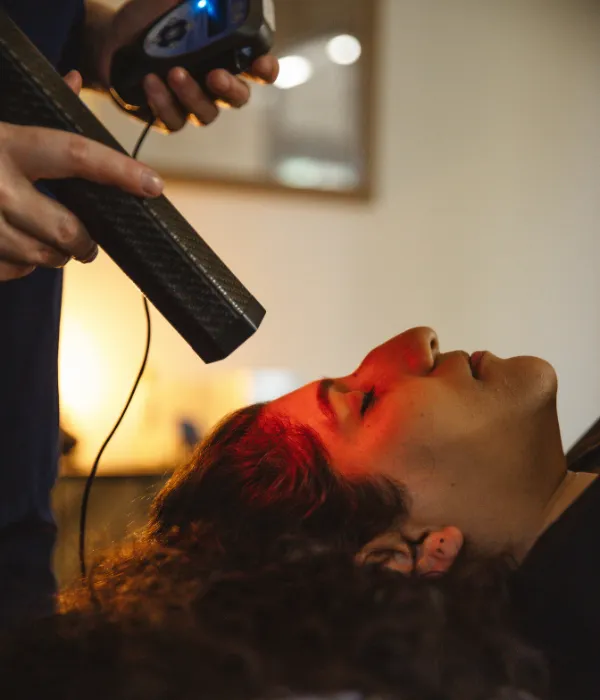
"This is one of the only devices in the stack that adapts to the client moment by moment. We're not pushing a setting. We're working with whatever the tissue is telling us that day."
Danielle Palmer, Natalie Sakamoto, & Christina Monet —
BioModulator Practitioners, The Ascent Collaborative
Reported Benefits
What clients report from regular sessions.
Less localized pain
Clients with chronic back, neck, joint, and post-surgical pain often report meaningful reductions within a series of sessions.
Faster recovery
Athletes and post-procedure clients use the BioModulator to shorten the window between injury or exertion and feeling like themselves again.
Calmer nervous system
The vagus reset protocol is one of the most-requested sessions. Clients describe leaving more grounded, less reactive, and sleeping better that night.
Improved tissue response
Areas that have felt stuck or unresponsive to massage, stretching, or chiropractic often soften and rehydrate after a few targeted sessions.
Better range of motion
Joint stiffness and old injury patterns frequently open up when the underlying voltage and signaling are restored.
Sustained energy
Clients note that energy returns at the cellular level rather than as a stimulant lift. Mornings get easier. Afternoons stop crashing.
Client outcomes vary. Sessions support general wellness and are not intended to diagnose, treat, cure, or prevent any disease.
Who It's For
The BioModulator is built for people who want a working body back.
Microcurrent therapy belongs in four conversations: pain that hasn't resolved, recovery that's stalled, nervous systems running too hot, and bodies looking for honest cellular support.
Chronic pain
For back, neck, joint, nerve, and post-surgical pain that hasn't responded to conventional approaches alone.
Athletes & high performers
For training cycles, injury recovery, and the maintenance work that keeps a body honest under load.
Nervous system support
For clients managing stress, sleep disruption, anxiety patterns, and looking for vagal tone work that holds.
Post-surgical & rehab
For wound healing, scar mobilization, and the recovery window after orthopedic or cosmetic procedures.
What a Session Feels Like
Your first visit, step by step.
01
Orientation & intake
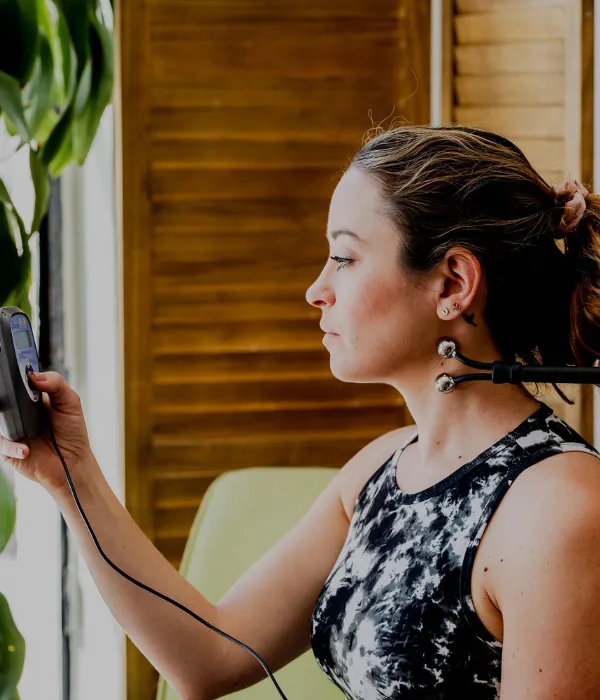
You meet with a frequency practitioner to walk through goals, history, current pain patterns, prior injuries, and any contraindications. This shapes the session plan.
02
Introductory Session
The first treatment is exploratory. The practitioner reads how your tissue responds, identifies priority sites, and chooses initial frequencies and waveforms.
03
Protocol building
After the first session, your practitioner builds a working protocol: cadence, sequence and frequency, pairing with other Ascent technologies, and target outcomes.
04
Sustainable CADENCE
Most clients settle into weekly or biweekly visits during a focused phase, then drop to a maintenance rhythm once the original goal is met.
The Science
Voltage, signaling, and adaptation. That's the mechanism.
Microcurrent therapy operates at the same order of magnitude as the body's own endogenous bioelectric currents. Where TENS units override the nervous system to block pain signals, microcurrent works below sensory threshold to support repair signaling rather than mask it. This is why clients often feel nothing during a session but report meaningful change afterward.
The signal in the Biomodulator is a patented waveform that specifically targets C-fibers of the peripheral nervous system, triggering the release of neurotransmitters and neuropeptides that influence inflammation, vascular tone, immune response, and recovery. That's not a symptomatic effect. It's a signaling event that touches multiple body systems simultaneously.
The BioModulator extends that approach by reading tissue response in real time and adjusting the waveform with it. A 2019 randomized trial out of Brooke Army Medical Center compared the Tennant BioModulator head-to-head against TENS and acupuncture in military service members with chronic pain. The BioModulator produced clinically meaningful pain reduction in a single treatment session. The device is also under active clinical study at Baylor College of Medicine for diabetic foot ulcer wound healing. This is the evidence-informed and experience-tested base the Ascent team works from.
Session basics at a glance
Length
30 to 60 minutes
Frequency
Weekly or biweekly during a focused phase
Contraindications
Pacemakers, implanted electrical devices, pregnancy
Position
Seated or lying down. ReCharge sessions: fully clothed. Practitioner-led sessions: undressed and draped.
Sensation
Light tingling at electrode sites, often nothing at all
Studies & Research
The evidence behind the BioModulator process.
Brand-Specific Research
Military Medical Research
Tennant BioModulator vs. TENS vs. Acupuncture for Chronic Pain in Military Service Members
A randomized trial at Brooke Army Medical Center (n=100) compared the Tennant BioModulator head-to-head against TENS and acupuncture for chronic pain. The BioModulator produced clinically meaningful pain reduction in a single treatment session, naming the device directly in the protocol.
Brand-Specific Research
ClinicalTrials.gov (NCT03821675)
Tennant BioModulator for Diabetic Foot Ulcer Wound Healing - Baylor College of Medicine
An FDA-regulated device trial at Baylor College of Medicine evaluates the Tennant BioModulator (AVAZZIA) for diabetic foot ulcer wound healing. The study tests the device's effect on tissue repair signaling and closure rates in a clinical wound-care setting.
Modality Research
Pain Research & Management
Microcurrent Nerve Stimulation vs. TENS for Masticatory Muscle Pain: Comparative RCT
A randomized controlled trial compared microcurrent nerve stimulation (the same modality the BioModulator operates within) against TENS for masticatory muscle pain. Microcurrent produced superior pain reduction, supporting the broader case for low-amperage, biofeedback-driven stimulation over conventional TENS.
Modality Research
Scientific Reports
TENS for Fibromyalgia-Like Syndrome in Long-COVID: Pilot RCT
A pilot randomized trial in Long-COVID patients presenting with fibromyalgia-like symptoms found that transcutaneous electrical stimulation produced measurable improvements in pain and fatigue. The finding supports the broader use of skin-delivered electrical therapies in chronic, post-viral pain syndromes.
Cellular voltage
Healthy tissue holds a measurable electrical charge near negative 25 millivolts. The BioModulator supports the body's ability to restore that baseline where it has dropped due to injury, inflammation, or chronic stress.
Biofeedback adaptation
The waveform changes in real time as tissue impedance changes. This is the difference between microcurrent and a fixed-output stimulator: the device responds to the body, not the other way around.
Peripheral nervous system
The signal engages the peripheral nerves and the sensory feedback loop. That engagement is what drives the pain reduction, vagal tone, and tissue response clients report from sessions.
Client outcomes vary. Sessions support general wellness and are not intended to diagnose, treat, cure, or prevent any disease.
Frequently Asked
The BioModulator, answered.
What is the BioModulator?
The BioModulator is an FDA-accepted microcurrent device built on Dr. Jerry Tennant's bioelectric medicine framework. It delivers biofeedback-modulated electrical impulses through the skin to support pain relief, cellular voltage restoration, and the body's own repair signaling.
How is this different from a TENS unit?
A TENS unit blocks pain signals with a higher-amperage, fixed-output current that overrides the nervous system. Microcurrent operates at a much lower amperage that mirrors the body's own bioelectric activity, and the BioModulator's waveform adapts to tissue response in real time rather than running a single setting.
How long is a session?
Most BioModulator sessions run 30 to 60 minutes depending on the protocol and the number of treatment sites. Vagus reset sessions are often on the shorter end. Wound healing and full-body protocols sit at the longer end.
What does a session feel like?
Most clients feel a light tingling at the electrode sites, often nothing at all once the practitioner has adjusted the output. The treatment runs below sensory threshold by design. Change is generally noticed afterward, not during.
What is the BioTransducer used for?
The BioTransducer connects to the BioModulator and delivers frequencies without direct skin contact. It allows treatment through clothing, casts, post-surgical dressings, and footwear, which expands what the device can do for wound care, orthopedic recovery, and harder-to-access sites.
Is the BioModulator safe?
The BioModulator is FDA-accepted and operates at currents below the threshold of harm for healthy tissue. It is contraindicated for clients with pacemakers, implanted electrical devices, or who are pregnant. The intake protocol screens for these conditions before any session.
Who runs BioModulator sessions at Ascent?
BioModulator sessions are delivered by three Ascent practitioners: Danielle Palmer, Natalie Sakamoto, and Christina Monet. Danielle and Natalie are co-founders and instructors at the International BioFrequency Association. All three have advanced training in frequency-based therapy.
How is this different from SCENAR?
Both devices are bioelectric and biofeedback-driven, but they're built on different traditions. SCENAR is an adaptive Russian neurostimulation device that works through cortical and peripheral feedback loops. The BioModulator is built on Dr. Tennant's American bioelectric medicine framework and emphasizes cellular voltage and broader systemic repair. Many Ascent clients use both.
BIOMODULATOR in Practice
Real clients. Real sessions.
Videos and conversations from athletes, practitioners, and longtime clients about what BioModulator has meant for their training, recovery, and day-to-day function.
For Practitioners & Practices
Bring BioModulator/BioTransducer to your practice.
Ascent Certified Technology, Inc. integrates the Senergy BioModulator and BioTransducer into practitioner offices, performance centers, and integrative practices nationwide. Every device in our portfolio has been stress-tested inside our own flagship center for over fifteen years, with real clients, real outcomes, and real revenue. When we recommend a microcurrent system, it's because we've already built protocols around it.
Two of Ascent's practitioners, Danielle Palmer and Natalie Sakamoto, serve as the official training partners for Senergy Wellness Group, the company behind the BioModulator and BioTransducer. As co-founders of the International BioFrequency Association, they train and certify practitioners globally on best practices, clinical protocols, and advanced BioModulator applications. For practitioners seeking formal training and certification, the IBFA is the recognized educational authority in the field. Visit ibfaofficial.com.
begin your ascent
Experience BioModulator at
The Ascent Collaborative.
Ascent runs a 4-unit BioModulator fleet under three practitioners trained at the highest levels of frequency medicine. Sessions are intake-led, protocol-built, and paired with the rest of the stack to deliver outcomes that hold.
Or call (949) 781-5769 · 150 Paularino Ave, Suite D-170, Costa Mesa, CA 92626
Often paired with BioModulator.
Bioelectric
SCENAR
Sister bioelectric modality. Adaptive Russian neurostimulation that complements the BioModulator for pain, recovery, and nervous system protocols.
Low-Power PEMF
BEMER
Microcirculation primer. Pairing BEMER before the BioModulator brings fresh blood flow to the tissue the microcurrent will then signal.
Red Light Therapy
LightStim
Cellular ATP support. Photobiomodulation pairs with microcurrent in recovery, anti-aging, and post-surgical healing protocols.

THE ASCENT COLLAB
Human optimization and regenerative wellness. Costa Mesa, Orange County, CA
Featured in Men's Journal as "The Gym of the Future"
Company


© 2026 The Ascent Collaborative. All rights reserved. | Privacy Policy
150 Paularino Ave, Suite D-170, Costa Mesa, CA 92626 | (949) 781-5769