Our Technologies · CVAC Therapy
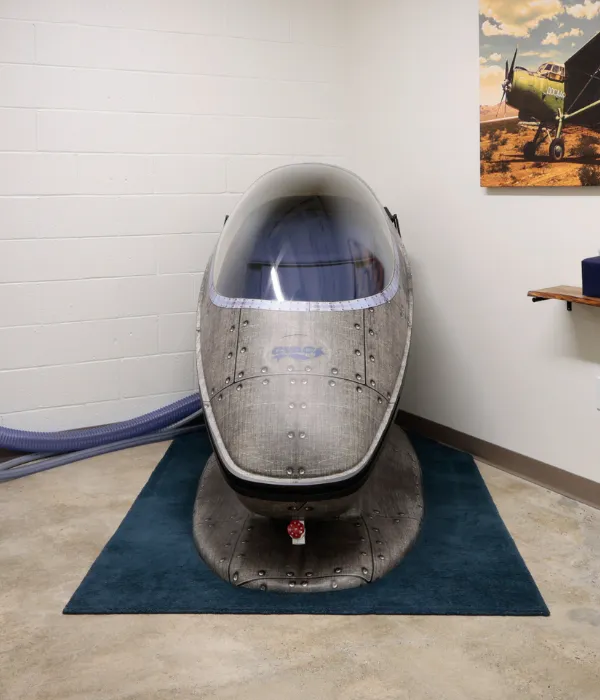
The CVAC
Pod.
CVAC stands for Cyclic Variations in Adaptive Conditioning. It applies precisely composed, rhythm-based changes in pressure, temperature, and air density to condition the body at a cellular level, passively, in twenty minutes, without exertion.
Public-access pods in the U.S.
3 of 25
Typical session
20 minutes
Operating since
2010
How It Works
The body adapts. The pod conditions it.
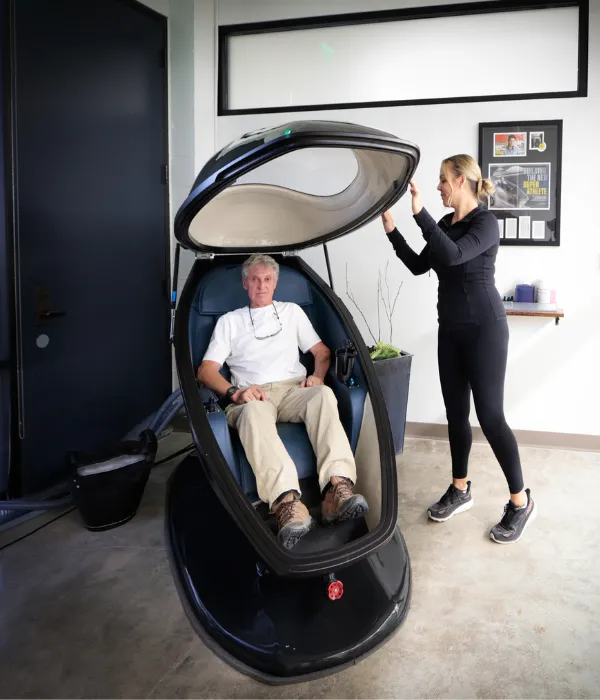
CVAC is a passive process built on the body's natural adaptation response to changing pressure. As you sit comfortably inside the pod, an external vacuum pump rhythmically adjusts the barometric pressure, simulating altitudes that range from sea level to roughly 22,500 feet, higher than Mt. Everest's base camp.
The entire body, blood, organs, muscle, down to each cell, is gently compressed and relaxed as the pressure curve cycles through peaks, plateaus, and drops. The air you breathe stays natural fresh air; no chemicals are used, and the percentage of oxygen never changes.
A common misconception
CVAC is not a hyperbaric chamber. It produces the opposite, a hypobaric environment, using low pressure to stimulate the body's own adaptation response rather than flooding it with external oxygen.
A typical session is twenty minutes. Because exposure at each altitude is brief, the side effects climbers can face during ascent and descent aren't a concern. You sit. You breathe normally. The pod does the work.
Reported Benefits
What clients report from regular sessions.
Every person can benefit from improved cellular fitness. Clients of all ages and activity levels use CVAC to support how their body recovers, performs, and adapts without the physical exertion of a traditional workout.
01 Increased stamina & endurance
Athletes integrating CVAC report a competitive edge across recovery, endurance, and power output, including improvements in VO₂ Max.
02 Faster recovery from exertion
Shortened post-workout recovery windows and reduced soreness following intense training or competition.
03 Mental clarity & cognitive fitness
An improved sense of alertness, focus, and mental acuity often noted within the first few sessions.
04 Reduced inflammation & swelling
Clients report decreases in systemic inflammation and localized swelling, particularly when paired with other recovery modalities.
05 Better-quality sleep
Deeper, more restful sleep with fewer wake-ups, a frequently reported outcome with consistent use.
06 Accelerated healing & pain reduction
Improved healing time and a reduction in chronic pain reported across post-surgical, injury, and overuse populations.
The CVAC process is intended to provide adaptation-based physical conditioning. CVAC technology is not intended to diagnose, treat, heal, manage, or prevent any disease or medical condition. Outcomes vary by individual and consistency of practice.
Who It's For
CVAC is built for people who adapt for a living.
You don't need to be an elite athlete to benefit. CVAC suits anyone whose body is being asked to do more; recover faster, perform sharper, age slower, or rebuild from the inside out.
Athletes & high performers
Professional and weekend athletes using CVAC for recovery, VO₂ Max improvement, and a passive way to add conditioning volume without adding training stress to the body.
Recovery & post-surgical clients
Clients rebuilding from surgery, injury, or extended downtime using CVAC alongside the rest of the Ascent stack to support circulation, lymphatic flow, and tissue healing.
Longevity & cellular health
Clients focused on aging well, maintaining cognitive sharpness, and building bioresilience using CVAC as a foundational layer in a long-term cellular health practice.
What a Session Feels Like
Your first visit, step by step.
01
Orientation & Education
Your first visit begins with a focused walkthrough of the process, what to expect, and several ear-clearing methods for safety and comfort throughout your sessions.
02
Introductory Session
You'll move through progressive Tier 1 sessions designed to gently increase the flexibility of your Eustachian tubes so your body can equalize comfortably at each pressure stage.
03
Profile Questionnaire
After completion, a short questionnaire profiles you into one of twelve categories that measure how your system copes with and adapts to specific stressors.
04
Customized Protocol
Once classified, you begin a CVAC journey programmed specifically for your profile. Our recommended ongoing protocol is two twenty-minute sessions, three times per week or three sessions, twice per week.
The Science
Adaptation, not exhaustion. That's the mechanism.
The CVAC process uses composed, proprietary patterned sequences of pressure to set up waves of tension and relaxation throughout the body. Those waves move in concert with the natural pulse of breathing, muscle contraction, and blood flow that occur during exercise but without the joint load, the heart rate, or the recovery debt.
By momentarily reducing the body's access to oxygen, CVAC asks the system to adapt. Over time, that adaptation conditions the body to use oxygen more efficiently across every mechanism that depends on it. The change in pressure, temperature, and air density works synergistically. That combination is the CVAC process.
CVAC Systems, the manufacturer, reports that spending up to forty minutes in the pod two to three times per week can support improved circulation, increased oxygen-rich blood cell counts, lactic acid clearance, and potentially stimulate mitochondrial biogenesis and stem-cell activity. This is evidence-informed and experience-tested drawn from manufacturer research and fifteen years of in-studio outcomes at Ascent.
Pressure cycle, at a glance
- Simulated altitude range — sea level to ~22,500 ft
- Oxygen percentage — remains constant
- Mechanism — hypobaric (low pressure), not hyperbaric
- Session length — 20 minutes per cycle
- Recommended cadence — 2× / 3 days or 3× / 2 days per week
- Air supply — natural, fresh; no chemicals
Studies & Research
The evidence behind the CVAC process.
The CVAC process has been the subject of peer-reviewed research and institutional studies, including a sham-controlled Stanford investigation of glucose metabolism, two University of Hawaii studies on arterial oxygen saturation, and a UC San Diego pilot on chronic pain. The full papers are available below.
Studies referenced
4
Primary Research | Peer-reviewed & institutional
Peer-Reviewed · Sham-Controlled
Cyclic Hypobaric Hypoxia Improves Markers of Glucose Metabolism in Middle-Aged Men
High Altitude Medicine & Biology, 2013 | Marquez, Rubinstein, Fattor, Shah, Hoffman, Friedlander | Stanford University & VA Palo Alto
Single-blinded, sham-controlled study of twenty-one middle-aged men at risk for metabolic syndrome. Over ten weeks of CVAC exposure (forty minutes per day, three days per week), the active group showed significant reductions in fasting glucose and plasma glucose AUC on oral glucose tolerance testing — with no changes in body weight, diet, or activity levels.
Peer-Reviewed
The Effect of Dynamic Intermittent Hypoxic Conditioning on Arterial Oxygen Saturation
Wilderness & Environmental Medicine, 2009 | Hetzler, Stickley, Kimura, LaBotz, Nichols et al. | University of Hawaii
Thirteen trained participants completed a seven-week CVAC protocol (mean exposure: thirty-one hours total). Arterial oxygen saturation improved 3.5%–5.9% across simulated altitudes from 2,740 m to 6,400 m. Notably, the dynamic CVAC protocol achieved acclimation responses comparable to traditional static-altitude studies, with substantially lower total exposure times.
Institutional Report
Cyclic Variable Altitude Conditioning & Arterial Oxygen Saturation Acclimation
University of Hawaii Manoa | IRB Closeout Report (CVAC 425) | Hetzler, Sargent, Kimura, Burgess, LaBotz, Nichols, Nakasone
IRB-approved institutional closeout report from the University of Hawaii. Eight aerobically trained subjects completed seven weeks of CVAC conditioning at progressive altitudes up to 6,860 m. Pulse oximetry confirmed significant SaO₂ improvements at every tested altitude — supporting CVAC's potential as a sea-level acclimation tool for travel to elevation.
Peer-Reviewed
Rapidly Cycling Hypobaric Pressure Improves Pain in Adiposis Dolorosa
Journal of Pain Research, 2010 | Herbst, Rutledge | UC San Diego
Pilot study of ten participants with Adiposis Dolorosa (Dercum's disease) completing twenty to forty minutes of the CVAC process daily for five days. Researchers observed significant decreases in pain catastrophizing and visual analogue pain scores, along with reduced bioimpedance and improved mental well-being — pointing to potential benefits in lymphatic and fluid dynamics.
Mechanistic Context | Why the CVAC stimulus works
These references from the broader literature on hypoxia, mitochondrial biology, and lymphatic physiology help explain why CVAC's rhythmic hypobaric stimulus produces the outcomes observed in the studies above.
Mitochondrial Biogenesis
Transient hypoxia drives nNOS–PGC-1α signaling
Neuroscience research demonstrates that brief hypoxic bouts can activate the nNOS–PGC-1α pathway and increase mitochondrial content in oxygen-sensitive tissues — directly aligned with CVAC's short, repeated dips in oxygen availability.
Nitric Oxide Pathway
NO–cGMP signaling regulates mitochondrial number & function
Multiple reviews describe how nitric oxide acts through cGMP and PGC-1α to upregulate mitochondrial biogenesis — a central adaptation mechanism engaged by intermittent hypoxic stimuli.
Cellular Resilience
Mitochondria are central to hypoxia adaptation
Mechanistic overviews show how hypoxia shifts cellular respiration and redox signaling in ways that protect cells — providing the framework for why intermittent hypoxia preconditioning enhances resilience.
Hypoxic Training
Targeted hypoxic stimuli induce measurable physiologic adaptation
A randomized controlled trial showed that six weeks of normobaric hypoxic training increased total hemoglobin mass in trained subjects — supporting the principle that controlled hypoxic exposure can drive meaningful adaptation.
Studies and research materials referenced on this page are provided for educational purposes and do not constitute medical advice. Findings from primary research apply to the populations and protocols studied; outcomes vary by individual and consistency of practice. Mechanistic-context references describe broader physiological pathways relevant to intermittent hypoxia and are not CVAC-specific. The CVAC process is intended to support adaptation-based physical conditioning and is not designed to diagnose, treat, heal, manage, or prevent any disease or medical condition.
Practitioner
Guided by the people who built this practice.

The Ascent Collaborative
Heather Hiniker
Founder & CEO | National Preferred CVAC Distributor
Heather has been operating CVAC technology since 2010 making The Ascent Collaborative one of the longest-running CVAC practices in the United States. After reversing a Rheumatoid Arthritis diagnosis through regenerative and bioenergetic protocols, she built the standard she wished existed. Today she leads Ascent's CVAC program and serves as the National Preferred CVAC Distributor through Ascent Certified Technology, Inc.
Frequently Asked
CVAC therapy, answered.
What should I expect during my first CVAC appointment?
During your initial visit, we introduce you to the experience and the sensations you'll feel inside the pod. The appointment begins with a focused walkthrough of the process and the ear-clearing methods we'll use throughout your sessions.
From there, you'll move through five Tier 1 introductory sessions of five minutes each — designed to gradually increase the flexibility of your Eustachian tubes. After all five are complete, a short questionnaire profiles you into one of twelve personalized categories, and you begin a customized, rhythmically programmed CVAC journey from that point forward.
How many CVAC pods are available for public use?
Many CVAC pods remain at private residences and aren't accessible to the public. The Ascent Collaborative is home to three of only twenty-five CVAC pods open to the public in the United States — making us one of the most accessible and highest-capacity CVAC locations in the country.
What's the difference between a CVAC pod and a hyperbaric chamber?
They work in opposite directions. A hyperbaric chamber uses high pressure to flood the body with oxygen — over time, some practitioners observe that the body can become reliant on that external oxygen.
A CVAC pod uses a low-pressure (vacuum) environment to rhythmically vary the density of air, stimulating the body's natural adaptation response. By momentarily reducing the body's access to oxygen, CVAC asks the system to use oxygen more efficiently across every mechanism that depends on it.
CVAC also adjusts temperature and air density in concert with the pressure changes — that combined cycle is what creates the CVAC effect.
Are there any conditions that would prevent a CVAC session?
Because CVAC's pressure changes are similar to an airplane's takeoff and landing, any condition that affects your ability to equalize ear pressure may mean postponing your session — including:
- Sinus allergies or infection
- Tooth pain or infection
- Cold or flu
- SCUBA or deep-sea diving within the last 24 hours
- Hyperbaric chamber use within the last 24 hours
We'll also ask you to eat beforehand if you're prone to low blood sugar, avoid dairy or other mucus-producing foods, and stay hydrated. A few practical notes: no laptops, no fountain pens or vape devices, shoes required, and loosen any water bottle lids before your session.
How often should I do CVAC sessions?
Our recommended ongoing protocol is two twenty-minute sessions, three times per week — or three sessions, twice per week. CVAC's effects compound with consistent practice; a single session offers an introduction, but the adaptive benefits build over weeks of steady use.
Can I purchase a CVAC pod through Ascent?
Yes. The Ascent Collaborative is the National Preferred CVAC Distributor through our sister company, Ascent Certified Technology, Inc. — placing CVAC pods in qualified practices, performance centers, and private installations across the United States.
For purchase information, visit ascentcertified.com, email [email protected], or call (833) 949-2555.
CVAC in Practice
Voices from inside the pod.
Videos and conversations from athletes, practitioners, and longtime clients about what CVAC has meant for their training, recovery, and day-to-day function.
For Practitioners & Practices
Bring CVAC to your practice.
Ascent Certified Technology, Inc. is the National Preferred CVAC Distributor placing pods in medspas, performance centers, and private installations. Every device in our portfolio has been stress-tested inside our own flagship center, with real clients and real outcomes, for over fifteen years.
begin your ascent
Experience CVAC at The Ascent Collaborative.
Three of only twenty-five publicly accessible CVAC pods in the United States. Twenty minutes per session. Operated under expert guidance since 2010. Discover what personalized, technology-driven care can feel like.
Or call (949) 781-5769 · 150 Paularino Ave, Suite D-170, Costa Mesa, CA 92626
Often paired with CVAC.
Low-Power PEMF
BEMER
Foundational circulation and microvascular support, the most common pairing with CVAC for recovery and longevity protocols.
Cellular Repair
BioCharger
Supports cellular signaling and protein folding stacked with CVAC for clients focused on age reversal and post-surgical recovery.
High-Power PEMF
Pulse PEMF
High-intensity electromagnetic field therapy paired with CVAC in performance and rapid-healing protocols.
THE ASCENT COLLAB
Human optimization and regenerative wellness. Costa Mesa, Orange County, CA
Featured in Men's Journal as "The Gym of the Future"
Company


© 2026 The Ascent Collaborative. All rights reserved. | Privacy Policy
150 Paularino Ave, Suite D-170, Costa Mesa, CA 92626 | (949) 781-5769