
Our Technologies | costa mesa, ca
The Sonix Plate.
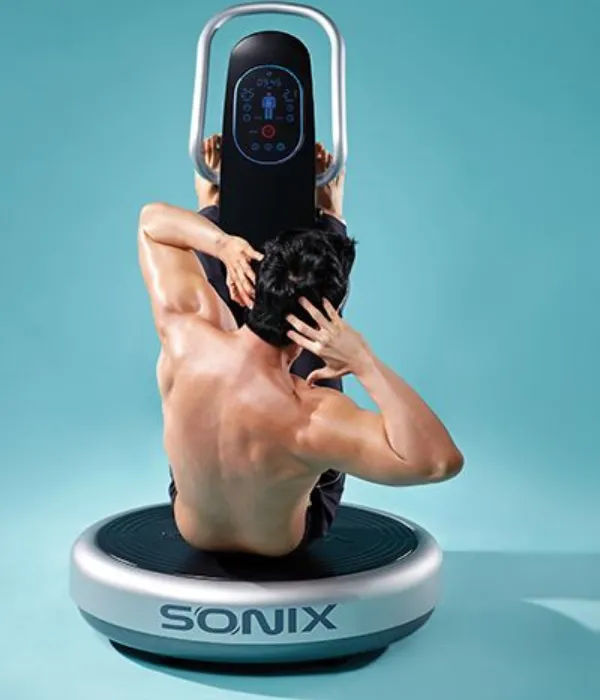
Sonix Whole-Body Vibration (WBV) is a sound-actuated vibration platform that delivers a true sine-wave, vertical-plane vibration from 3 to 50 Hz. It uses a magnetic voice-coil speaker, not a spin motor, to transmit precise vibrational energy through the body, triggering involuntary neuromuscular contraction in muscles, lymphatics, and connective tissue.
How It Works
The body adapts. The plate signals it.
The Sonix is built around a powerful magnetic voice coil, the same engineering principle as a high-end speaker. Instead of a mechanical motor jerking the platform up and down, the Sonix produces a true sine wave: a smooth, coherent, sound-driven vibration that decelerates slightly before changing direction, eliminating the harsh saw-tooth motion of conventional plates.
When the platform vibrates, muscle spindles fire in response. At 30 Hz, the muscles contract and release roughly 1,800 times in a single minute, without conscious effort. That involuntary signaling ripples through musculature, connective tissue, lymphatic flow, and the vestibular system, creating an exercise stimulus the body experiences as effortful, even when the client is simply standing still.
"Most vibration plates are a workout. The Sonix is a signal. The sine wave is what makes it tolerable for clients who can't tolerate impact, and effective for athletes who already do."
The Ascent Collaborative
benefits
What clients report from regular sessions.
Improved strength
Involuntary neuromuscular activation supports muscle recruitment and tone in clients who can't load joints conventionally.
Better balance & proprioception
Vestibular and postural systems are challenged at low frequencies, sharpening reaction and stability over time.
Bone density support
Vertical-plane loading provides a non-impact mechanical stimulus shown in clinical trials to support BMD in the spine and hip.
Enhanced lymphatic flow
Rhythmic vibration assists lymphatic motility and venous return, supporting circulation and tissue drainage.
Increased flexibility & mobility
The rapid contract-release cycle supports range of motion and tissue suppleness without prolonged stretching.
Whole-system stimulation
Vibration reaches not only musculature but internal organs and the central nervous system, supporting whole-body resilience.
Client outcomes vary. Sessions support general wellness and are not intended to diagnose, treat, cure, or prevent any disease.
great For
Sonix is built for people who need stimulus without strain.
From athletes building reactive strength to older clients protecting bone density and balance, the plate meets clients where their nervous system is.
Athletes & high performers
Warm-up activation, post-training recovery, and high-frequency neuromuscular priming on training days.
Bone & joint health
Non-impact mechanical loading for clients managing osteopenia, osteoporosis, or post-orthopedic recovery.
Balance & aging well
Vestibular and proprioceptive training for fall prevention and confidence in older clients and post-rehab populations.
Lymphatic & circulatory support
A passive movement stimulus for clients with sluggish lymphatic flow, post-surgical swelling, or sedentary recovery.
What a Session Feels Like
Your first visit, step by step.
01
Orientation & intake
A brief screening for contraindications and a conversation about your goals: strength, bone health, lymphatic flow, or balance.
02
Introductory Session
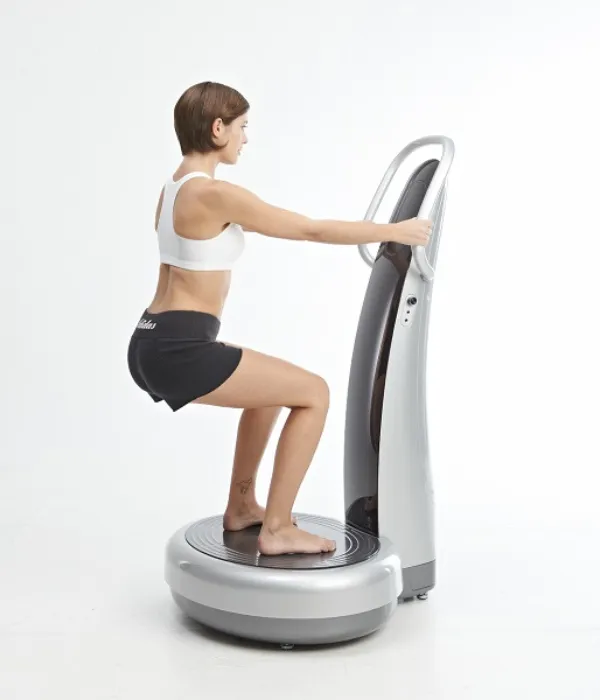
Shoes off. A 5- to 10-minute introductory session at lower frequency and amplitude, with stance coaching from your practitioner.
03
Protocol building
Frequency, amplitude, position, and session length are tuned to your goal. Strength training uses higher Hz. Lymphatic and recovery work uses lower.
04
Sustainable protocol
Most clients land on two to four sessions per week, often paired with BEMER, BallancerPro, or the CVAC Pod within a broader stack.
The Science
Stimulus, not strain.
That's the mechanism.
Whole-body vibration works through a stretch-reflex response. When a vibrating platform moves the body vertically at a specific frequency, muscle spindle receptors detect the rapid length changes and fire signals to the spinal cord, which sends motor commands back to the muscle. The result is an involuntary contract-release cycle that occurs dozens of times per second, recruiting motor units the body would otherwise activate only under heavy load.
The Sonix platform's sine-wave actuation matters here. Mechanical plates produce a saw-tooth or square wave that creates jarring directional changes, which the nervous system reads as cellular stress. The Sonix's smooth deceleration before each direction change keeps the stimulus coherent and tolerable, even at low frequencies. This is evidence-informed and experience-tested: the same neuromuscular signaling that strengthens elite athletes can be dosed gently enough to support bone density in postmenopausal clients and balance in clients managing Parkinson's disease.
Session basics at a glance
Length
10 minutes typical
Frequency
2 to 4 sessions per week
Position
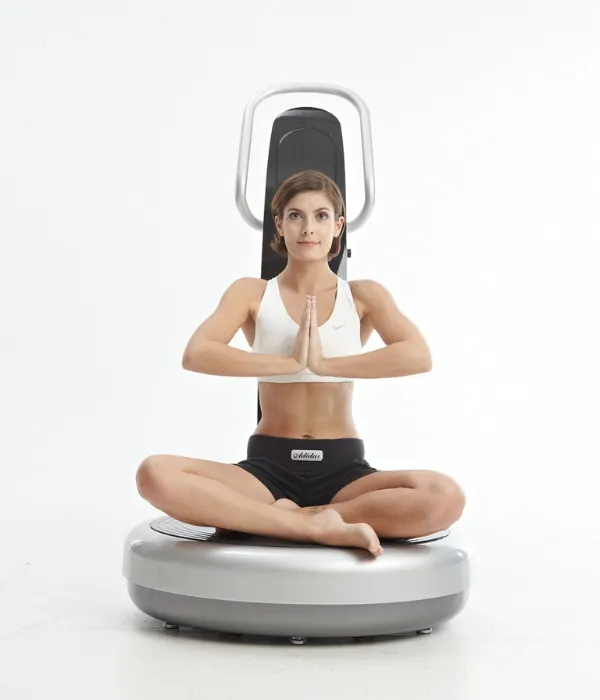
Standing, seated, or supported
What to Wear
Comfortable clothing, shoes off
Not For
Pregnancy, pacemaker, acute thrombosis, recent surgery, severe cardiovascular disease, epilepsy. Full screen at intake.
Studies & Research
The evidence behind whole-body vibration.
Sonix is a specific implementation of whole-body vibration therapy. The brand itself has not been the subject of indexed peer-reviewed clinical trials, which is true of most consumer-grade vibration platforms. The science cited below is modality-level research on whole-body vibration, the underlying mechanism the Sonix delivers. Each study used a vibration plate operating within the same general frequency and amplitude window the Sonix supports.
Modality Research
Chinese Medical Journal
RCT: Whole-Body Vibration on Bone Density and Back Pain in Postmenopausal Osteoporosis
In 116 postmenopausal women, six months of WBV at 30 Hz and 5 mm amplitude (10 min/day, 5x/week) significantly increased lumbar spine BMD by 4.3% and femoral neck BMD by 3.2% versus controls, who lost density. Chronic back pain was significantly reduced at both 3- and 6-month follow-up. Ruan et al., 2008. PMID: 18710630.
Modality Research
Frontiers in Neurology
RCT: Whole-Body Vibration Program in Fibromyalgia
In 40 fibromyalgia patients, a 12-week rotational WBV program produced significant improvements in functional disability, static equilibrium, vibration sensitivity, and pain sensitivity in the intervention group, with no change in the control group. Mingorance et al., 2021. PMID: 34149596.
Modality Research
Archives of Physical Medicine and Rehabilitation
Randomized Trial: WBV vs. Physiotherapy for Balance in Parkinson's Disease
In 27 patients with dopa-resistant balance impairment, 30 WBV sessions (15 min, twice daily, 5 days/week) improved Tinetti Balance Scale scores from 9.3 to 12.8 and reduced dynamic posturography sway by approximately 24%. Conventional physiotherapy controls showed no significant change. Ebersbach et al., 2008. PMID: 18295614.
modality research
Brazilian Journal of Medical and Biological Research
Systematic Review & Meta-Analysis: WBV in Postmenopausal Osteoporosis
Pooling 13 RCTs with 783 postmenopausal patients, WBV significantly increased lumbar spine BMD (WMD=0.018, p=0.011) and femoral neck BMD (WMD=0.005, p=0.049), and reduced pain VAS scores (WMD=−0.786, p=0.0027) versus controls. Li, Liang, Gao & Zong et al., 2024. PMCID: PMC11540256.
Mechanistic Context
Stretch-reflex activation
Vibration triggers the muscle spindle's stretch reflex, recruiting motor units involuntarily. The body experiences a workload it never consciously initiated.
Mechanotransduction
Bone and soft tissue translate mechanical loading into cellular signals. Low-magnitude, high-frequency loading supports osteoblast activity and tissue remodeling.
Vestibular & proprioceptive input
Rapid postural perturbations recruit balance systems, sharpening reaction time and stability without the fall risk of dynamic balance training.
Mechanism explainers are educational and reflect the established physiology of whole-body vibration. They are not claims of medical effect for any individual client.
Frequently Asked
Sonix Whole-Body Vibration, answered.
What is Sonix Whole-Body Vibration?
Sonix is a sound-actuated whole-body vibration plate. The client stands, sits, or lies on a vibrating platform that delivers a true sine-wave, vertical-plane vibration from 3 to 50 Hz. Muscles, lymphatics, and connective tissue respond with rapid involuntary contract-release cycles, producing a stimulus the body reads as exercise without conscious effort.
How long is a Sonix session?
Sessions are typically 10 minutes. Up to 190 calories can be expended in a single 10-minute session at higher intensities. Most clients run two to four sessions per week, often paired with other technologies in the Ascent stack.
What makes Sonix different from a standard vibration plate?
Most vibration plates use a mechanical spin motor or linear actuator, producing a saw-tooth or square-wave motion that the body reads as harsh. The Sonix uses a magnetic voice-coil speaker to produce a true sine wave, with smooth deceleration before each direction change. It is the only platform with strictly vertical motion, 1 Hz frequency precision from 3 to 50 Hz, amplitude adjustable from 0 to 22 mm, and a coherent low-frequency electromagnetic field. That combination is unique in the category.
Is whole-body vibration backed by research?
Yes. Whole-body vibration as a modality has been studied in randomized controlled trials and meta-analyses for bone density, balance, pain, and fibromyalgia symptoms. The Sonix brand itself has not been the subject of indexed peer-reviewed trials, which is common for vibration plates generally. The science page summarizes four representative trials from the broader modality literature.
Who shouldn't use the Sonix?
Whole-body vibration is contraindicated during pregnancy, with a pacemaker, acute thrombosis, serious cardiovascular disease, recent surgical wounds, recent hip or knee implants, acute hernia, severe diabetes, epilepsy, recent infections, severe migraines, tumors, recently placed IUDs or metal implants, and electrolyte imbalance. Clients are screened at intake. Frail clients and children require physician clearance and supervision.
What does a session feel like?
At low frequencies, the sensation is a gentle, rhythmic buzz through the legs and torso. At higher frequencies, muscles fatigue noticeably within a few minutes, comparable to holding a static load. Because the Sonix uses a sine wave, the sensation is smooth rather than jarring. Shoes are removed so the vibration travels efficiently through the body.
How is Sonix different from PEMF therapy?
The Sonix is a mechanical vibration technology. It does emit a coherent low-frequency electromagnetic field as a byproduct of its voice-coil design, but its primary mechanism is physical movement of the body. BEMER and PULSE PEMF, by contrast, deliver targeted pulsed electromagnetic fields without mechanical motion. The technologies pair well within a broader stack but address different physiologies.
Can Sonix replace strength training?
For most clients, no. The Sonix supplements training, it does not replace it. The exception is clients who cannot tolerate conventional loading: post-surgical clients, clients managing osteoporosis, or older clients with mobility limitations. In those cases, the Sonix can be the primary loading stimulus, used within a broader practitioner-guided protocol.
For Practitioners & Practices
Considering Sonix for your practice or home?
Whole-body vibration is one of the easiest technologies to staff and one of the most consistent revenue drivers in a wellness practice. We've run Sonix on our floor since 2010. If you're evaluating it for your space or your home, we'll share what's worked, what hasn't, and how to integrate it cleanly into an existing stack.
begin your ascent
Experience Sonix at The Ascent Collaborative.
One of the longest-running biohacking centers in the United States. Sound-actuated vibration, tuned to your goal by a practitioner who has run this tech across thousands of client sessions since 2010.
Or call (949) 781-5769 · 150 Paularino Ave, Suite D-170, Costa Mesa, CA 92626
Often paired with Sonix.
Lymphatic Drainage
BallancerPro
Layered after Sonix to drive the lymphatic flow vibration mobilizes. The most common pairing for recovery and post-surgical clients.
Low-Power PEMF
BEMER
Stacked with Sonix for microvascular support. Vibration moves tissue, BEMER conditions the circulation that nourishes it.
Adaptive Conditioning
CVAC Pod
Cyclic variations in adaptive conditioning — stacked with Sonix in performance and longevity protocols for cellular-level recovery.

THE ASCENT COLLAB
Human optimization and regenerative wellness. Costa Mesa, Orange County, CA
Featured in Men's Journal as "The Gym of the Future"
Company


© 2026 The Ascent Collaborative. All rights reserved. | Privacy Policy
150 Paularino Ave, Suite D-170, Costa Mesa, CA 92626 | (949) 781-5769