Our Technologies | foundational technology
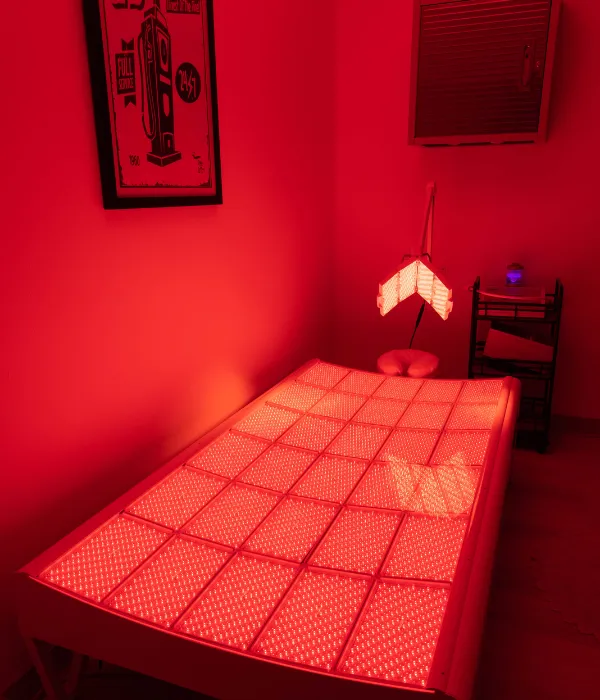
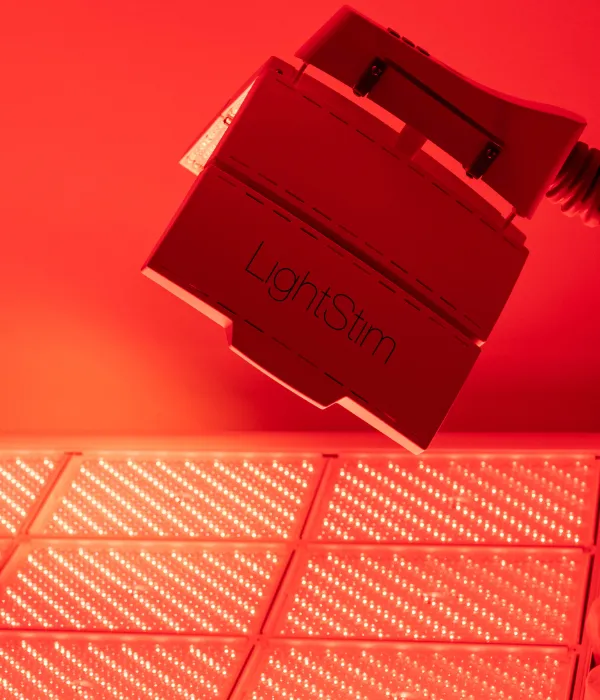
The LightStim LED Bed & ProPanel.
LightStim is photobiomodulation therapy, the clinical name for medical-grade red and near-infrared light therapy. It works by delivering specific wavelengths the body absorbs through chromophores inside each cell, triggering ATP production, nitric oxide release, and the cellular signaling that drives recovery, circulation, and skin repair.
Red Light Therapy | Foundational Device | Costa Mesa, CA
How IT Works
The cells absorb the light. The body does the rest.
The LightStim LED Bed and ProPanel deliver four specific wavelengths simultaneously: 630 nm and 660 nm in the red spectrum, plus 855 nm and 940 nm in the near-infrared spectrum. This is LightStim's patented MultiWave® technology, and the wavelength stack is the entire mechanism. Chromophores inside the mitochondria absorb these wavelengths, the absorption stimulates cytochrome c oxidase, and the cell produces more ATP, the body's fuel currency.
At the same time, the longer wavelengths trigger nitric oxide release, which relaxes blood vessel walls and increases local circulation. The combined effect is more cellular energy plus more nutrient delivery plus reduced oxidative stress. No heat is involved. The mechanism is entirely photochemical, which is why LightStim holds the only FDA Class II clearance for a full-body LED bed in the United States.
"Most red light devices give you one or two wavelengths. The LightStim Bed gives you four at once, full body, and it's the only one of its kind the FDA has cleared. That combination is why we built our recovery and skin protocols around it."
The Ascent Collaborative
Lightstim benefits
What clients report from regular sessions.
Faster muscle recovery
Reduced soreness and stiffness in the 24 to 72 hours following heavy training, surgery, or physical work. Most clients run sessions within the day or two after intense load.
Visible skin support
Improved tone, reduced appearance of fine lines, and a more even complexion over consistent 8 to 12 week protocols. Two of the four wavelengths match LightStim's FDA-cleared wrinkle device.
Reduced joint and muscle pain
The FDA-cleared indication. Clients managing arthritic pain, muscle spasm, and chronic stiffness often pair sessions two to three times a week during flare-ups.
Improved local circulation
Through nitric oxide release and vasodilation. Clients often pair this with BEMER or CVAC for a fuller cardiovascular conditioning effect.
Easier sleep on session nights
Many clients find the LED Bed so calming they drift into sleep mid-session. Some track noticeably more restorative rest on devices like the Oura Ring afterward, making each session a full-body reset.
Faster healing on minor wounds and bruising
Increased blood flow and ATP availability speed up the body's natural repair signaling. Used routinely for post-procedure recovery alongside lymphatic work.
Client outcomes vary. Sessions support general wellness and are not intended to diagnose, treat, cure, or prevent any disease.
Who it's For
LightStim is built for people who want measurable cellular support.
Red light therapy is foundational, not flashy. It is the wavelength layer that compounds quietly underneath every other protocol in the stack: recovery, longevity, skin, performance.
Anti-aging & cellular health
Clients focused on reversing visible signs of aging and supporting collagen, mitochondrial efficiency, and skin tone over time.
Recovery & tissue repair
Athletes, post-op clients, and anyone managing soft-tissue load or chronic pain who needs faster, more reliable cellular recovery.
Skin & visible signs of aging
Clients running a structured 8 to 12 week protocol for wrinkles, tone, and clarity. The wavelengths target collagen and elastin production directly.
High performers protecting their baseline
Executives, creatives, and parents who want a consistent, low-friction way to support energy, sleep, and cellular health weekly.
What a Session Feels Like
Your first visit, step by step.
01
Orientation & intake
We review your goals, lifestyle, and any photosensitivity concerns to personalize your experience. Most clients come in for recovery, skin health, relaxation, or overall cellular support. The intake process is simple and takes about ten minutes.
02
Introductory Session
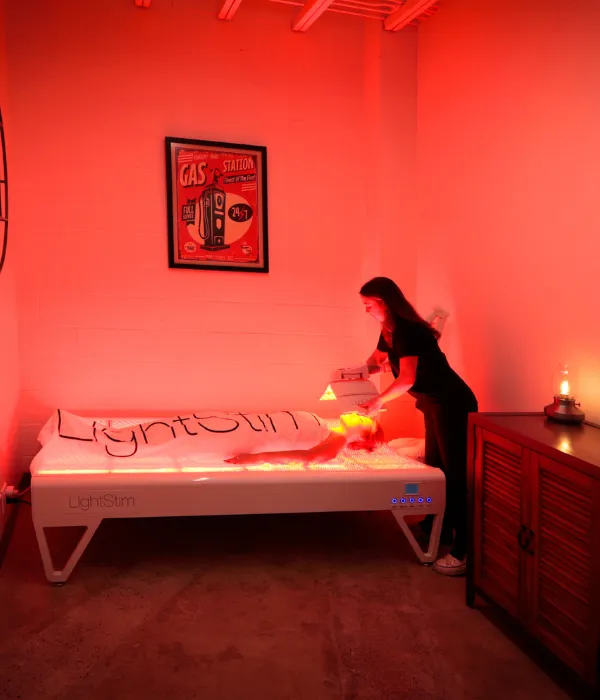
Clients relax on their back on the LED Bed- face-up for 20 minutes while the ProPanel targets the face or another desired area, then turn face-down for another 20 minutes. LightStim’s patented design maintains an optimal distance from the light source for consistent full-body exposure without the need for a traditional canopy.
03
Protocol building
Based on your goals, we create a personalized cadence. When first starting, we generally recommend three sessions within the first 10 days to help jumpstart ATP production, followed by weekly maintenance sessions. Specific needs and recommendations will vary based on the individual.
04
Sustainable protocol
LightStim integrates easily into a consistent wellness and recovery routine. During the session, we often stack it with NanoVi and NuCalm, or pair it with BEMER beforehand and/or CVAC afterward for a more layered recovery experience.
The Science
Photobiomodulation is well-studied. The wavelengths are the mechanism.
The science behind LightStim is the science of photobiomodulation, or PBM. When red and near-infrared wavelengths in the 600 to 1000 nm range hit the skin, chromophores inside the cell absorb the photons. The primary target is cytochrome c oxidase, a key enzyme in the mitochondrial electron transport chain. Absorption stimulates ATP production, modulates reactive oxygen species, and triggers downstream nitric oxide release.
The clinical evidence base for these wavelengths is substantial: well-controlled RCTs on wrinkle reduction, collagen density, muscle recovery, and circulation are published across dermatology, sports medicine, and laser surgery journals. The 100% improvement in fine lines at 8 weeks shown in LightStim's own FDA submission is consistent with what the broader 630 to 660 nm literature reports. This is evidence-informed and experience-tested work, not a wellness trend.
Session basics at a glance
Typical length
Bed - 40 minutes per session
Pro Panel - 20 minutes per session
Frequency
3 times in the first 10 days, 1 to 2 times per week for maintenance
Environment
Lying in the LED Bed for full-body, or seated/lying under the ProPanel for targeted work
What to wear
Skin exposed to the light delivers the strongest effect. Most clients wear minimal clothing or undergarments. Protective eyewear provided. For optimal light absorption, we recommend arriving with clean skin and minimal makeup, SPF, or heavy skincare products when possible.
Contraindications
Active photosensitivity, untreated melanoma, pregnancy (precautionary); reviewed at intake
Studies & Research
The evidence behind the LightStim wavelengths.
Brand-Endorsed Research
ClinicalTrials.gov
LightStim LED Bed Clinical Trial: Hypertension & Endothelial Function
A device-specific registered trial (NCT04006158, n=40) using the LightStim LED Bed itself to study red and near-infrared phototherapy's effect on blood pressure and endothelial function. The only registered clinical trial in the public registry using LightStim's exact full-body bed.
Modality Research
Photomedicine and Laser Surgery
Red & Near-Infrared Light Reduces Fine Lines, Wrinkles, and Increases Intradermal Collagen Density
Wunsch and Matuschka, 2014. Controlled trial of 136 participants using a polychromatic full-body protocol most directly comparable to the LightStim Bed exposure pattern. Significant improvement in skin roughness, fine lines, and measurable collagen density increase.
Modality Research
Journal of Clinical Medicine
PBM Therapy for Hypertension: Systematic Review & Meta-Analysis of RCTs
2025 systematic review documenting red and near-infrared PBM reducing both systolic and diastolic blood pressure through the nitric oxide pathway. Directly supports the mechanistic claim behind LightStim's circulation indication.
Modality Research
Journal of Investigative Dermatology
660 nm LED Regulates Skin Collagen and MMP-1: Clinical Correlation Study
Barolet et al., 2009. Demonstrates that 660 nm light, one of LightStim's four wavelengths, regulates collagen production and matrix metalloproteinase-1 activity in human skin. A mechanistic anchor for the wrinkle and skin-tone claims.
Three mechanisms working at once.
ATP production
Red and near-infrared light is absorbed by mitochondrial chromophores, stimulating cytochrome c oxidase and increasing the cell's production of ATP, the molecular fuel that powers every cellular process.
Nitric oxide release
The longer wavelengths trigger nitric oxide release, relaxing blood vessel walls and increasing local circulation. This is the same vasodilation pathway the FDA cited in LightStim's circulation clearance.
Collagen and elastin signaling
The 630 nm and 660 nm wavelengths directly signal fibroblasts to produce collagen and elastin, the structural proteins that determine skin firmness, tone, and the appearance of fine lines.
Photobiomodulation is non-thermal. The mechanism is entirely photochemical, not heat-based.
Frequently Asked
LightStim, answered.
How long does a LightStim session take?
Session time booked is 60 mins - the actual treatment time on the bed is 40 mins (the panel is used for the first 20 mins while they’re on their back). The ProPanel can be stacked during other various treatments such as the BioCharger, BEMER, PULSE, NanoVi, BioModulator, and Transducer
What is the difference between the LightStim LED Bed and the ProPanel?
The LED Bed is a full-body photobiomodulation treatment and the only one of its kind with FDA Class II clearance. The ProPanel is a targeted device used for specific areas: face, joint, post-procedure site, or one focused region. Most clients use the Bed as their foundational treatment and the ProPanel for layered targeted work.
How is LightStim different from other red light therapies?
LightStim uses patented MultiWave® technology to deliver four wavelengths simultaneously: 630 nm, 660 nm, 850 to 855 nm, and 940 nm. Most consumer red light panels deliver one or two wavelengths. The full-body LED Bed is also the only full-body photobiomodulation bed to hold OTC FDA Class II clearance for pain, stiffness, muscle spasm, and increased local circulation. LightStim uses a patented acrylic surface designed to minimize light distortion while keeping the body at an optimal distance from the LEDs. Because light energy disperses over distance, proximity to the light source plays an important role in consistent delivery and overall treatment efficacy. This is where LightStim really sets the bar.
How often should I do red light therapy to see results?
Cadence depends on the goal. Protocols typically run three sessions in the first 10 days. Recovery protocols often run two to three times a week during training or rehab phases. Maintenance lands at one to two sessions weekly. We design the protocol with you at intake.
Does the LightStim LED Bed use heat?
No. LightStim does not work through heat but may feel warm. It works through specific wavelengths of light that the body absorbs and uses to support cellular function. The mechanism is photochemical, not thermal.
Is LightStim safe?
LightStim LED Light Therapy is non-invasive and backed by over 200 medical and university studies showing no negative side effects. The Bed and ProPanel both hold FDA Class II clearance. Protective eyewear is provided.
Who should not use LightStim?
Anyone on photosensitizing medications, anyone with untreated melanoma or active skin cancer, and pregnant clients (precautionary) should review with a practitioner before booking. We screen for these at intake.
How does LightStim support the body at a cellular level?
The body absorbs the specific wavelengths and converts them into usable cellular energy, supporting ATP production, nitric oxide release, and collagen signaling. The effect is foundational: it gives every cell more of what it needs to do its job.
Real clients. Real sessions.
Hear from the athletes, professionals, and longtime clients who anchor their recovery and longevity around LightStim at The Ascent Collaborative.
For Practitioners & Practices
Bring LightStim to your practice.
Ascent Certified Technology distributes the full LightStim portfolio: the LED Bed, the ProPanel, and the FDA-cleared handhelds. Every device in the portfolio has been stress-tested inside our own flagship center with real clients, real protocols, and real revenue. When we place a LightStim system, we come with the operating context: how to staff it, how to package it, how to pair it inside stacks that clients renew on.
begin your ascent
Experience LightStim at The Ascent Collaborative.
Few centers in Orange County run a two bed, four pro-panel LightStim fleet, and fewer still pair it inside stacks designed by practitioners who have lived in this work for over a decade. Both the LED Bed and the ProPanel are available, and we will design the cadence around your goal.
Or call (949) 781-5769 · 150 Paularino Ave, Suite D-170, Costa Mesa, CA 92626
Often paired with LightStim.
High-Power PEMF
Pulse PEMF
Deep-tissue PEMF for performance and recovery. Layered with the ProPanel for athletes targeting a specific joint or muscle group, the combination is one of our most-requested recovery stacks.
Cellular Repair
NanoVi
Targeted protein folding and oxidative-stress repair. Stacked with LightStim, NanoVi extends the cellular repair signal LightStim initiates, the most-requested longevity and anti-aging pairing in the stack.
Lymphatic Compression
BallancerPro
Lymphatic drainage and post-procedure recovery. Paired with LightStim for clients in post-cosmetic, post-surgical, or inflammation-driven protocols where tissue repair is the goal.
THE ASCENT COLLAB
Human optimization and regenerative wellness. Costa Mesa, Orange County, CA
Featured in Men's Journal as "The Gym of the Future"
Company


© 2026 The Ascent Collaborative. All rights reserved. | Privacy Policy
150 Paularino Ave, Suite D-170, Costa Mesa, CA 92626 | (949) 781-5769