Our Technology Stack | Costa Mesa, CA
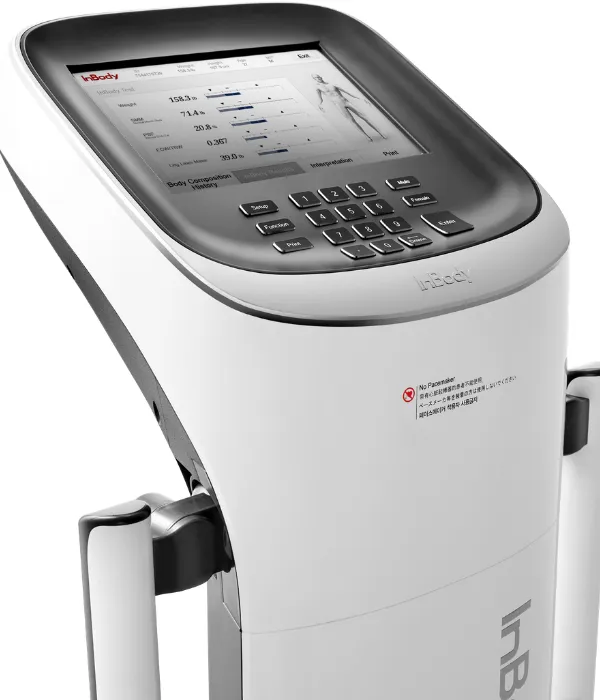
The InBody 970.
A medical-grade bioelectrical impedance analysis device that quantifies body composition, fluid balance, and cellular integrity. The InBody 970 sends a safe, low-level current through the body and reads the resistance of different tissues to produce precise measurements in under a minute.
How It Works
The body conducts. The InBody measures it.
Bioelectrical impedance analysis (BIA) was first established in the 1960s as a method for measuring body composition. The InBody 970 uses direct segmental multi-frequency BIA: it sends a low-level alternating current through eight tactile electrodes across five body segments, then reads the impedance at six different frequencies.
Different tissues conduct electricity at different rates. Muscle and water conduct easily; fat resists. By measuring those differences across multiple frequencies and segments, the InBody 970 separates intracellular water from extracellular water, isolates visceral fat, and calculates phase angle: a direct read on cellular membrane integrity and one of the most meaningful markers we track at Ascent.
"The InBody 970 doesn't estimate. It measures. No assumptions based on age, sex, or ethnicity: just objective data, scan after scan, so we can see what's actually changing at the cellular level."
The Ascent Collaborative
What an InBody scan reveals.
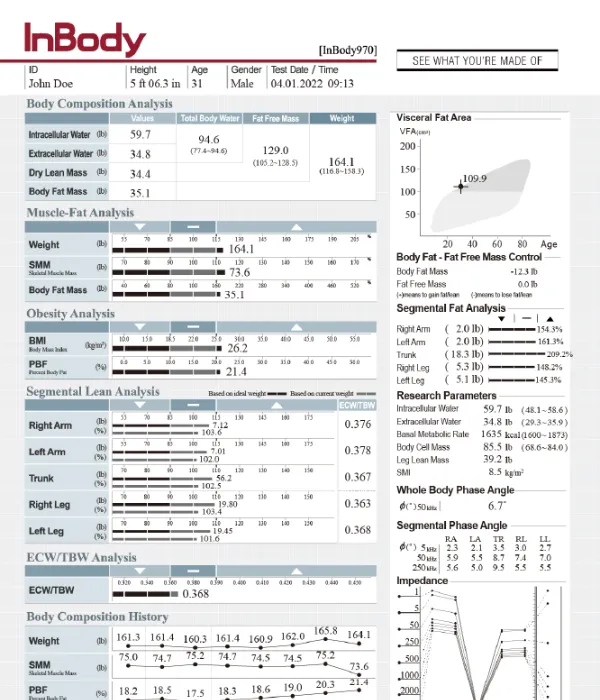
Clients arrive expecting a body fat number. They leave with a far more meaningful picture. These are the markers a 970 scan brings into focus.
Phase Angle
A direct measurement of cell membrane integrity. Higher phase angle reflects cellular resilience; lower phase angle correlates with illness, aging, and reduced repair capacity.
Visceral Fat
The fat stored around internal organs that drives metabolic risk. The 970 isolates it from subcutaneous fat so the number actually means something.
Segmental Muscle & Fat
Distribution across arms, legs, and trunk. Useful for catching asymmetries, tracking rehab progress, and confirming targeted protocols are working.
Intracellular & Extracellular Water
The ratio that flags inflammation, dehydration, and fluid retention long before they show up as symptoms.
Skeletal Muscle Mass
Quantified independently from total lean mass. Important for tracking sarcopenia, recovery from injury, and the actual return on a training program.
Baseline & Progress Data
A repeatable, objective measurement that turns "how do you feel" into a number you can track session over session, quarter over quarter, year over year.
The InBody 970 is an assessment and tracking tool. It is not intended to diagnose, treat, cure, or prevent any disease. Results inform protocol design at Ascent and are not a substitute for medical evaluation.
Who It's For
The InBody 970 is built for people who want data, not guesses.
Anyone serious about cellular health benefits from a baseline. These are the client profiles where InBody data changes the trajectory most.
Longevity & Anti-Aging
Phase angle is one of the few markers that can be moved in either direction. Track it quarterly to see if your protocol is actually slowing biological aging.
High Performers & Athletes
For training cycles, injury recovery, and the maintenance work that keeps a body honest under load.
Recovery & Rehab
Track asymmetries, fluid shifts, and muscle return after surgery, injury, or extended downtime. Objective progress when the mirror lies.
Metabolic Health
Visceral fat, water distribution, and inflammation patterns that show up in InBody data before they show up in lab work.
What a Session Feels Like
Your first visit, step by step.
01
Pre-scan prep
Arrive hydrated but not having eaten in the last few hours. No vigorous exercise immediately beforehand. Light clothing, no metal jewelry on the hands or feet.
02
The scan
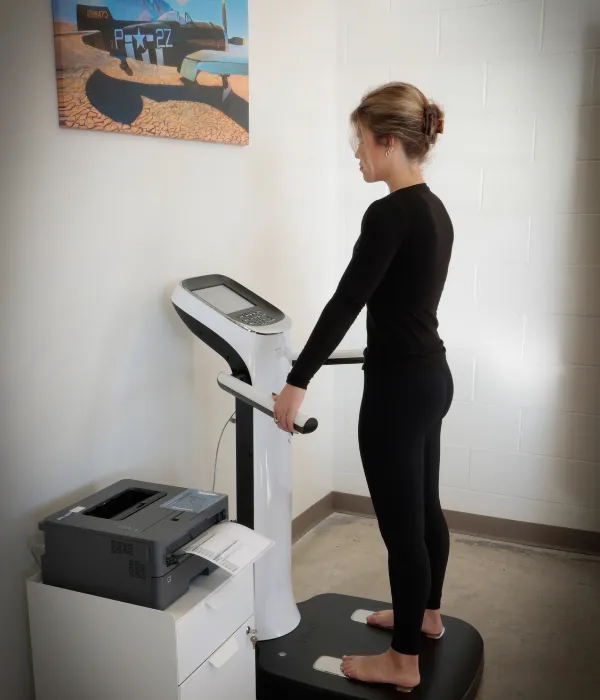
Stand on the platform, grip the hand electrodes, and stay still for roughly 45 seconds. No needles, no fasting, no discomfort. The current is undetectable.
03
Result review
A practitioner walks you through the full result sheet: phase angle, visceral fat, segmental distribution, water balance, and what each number actually means for you.
04
Protocol & recheck cadence
Your baseline informs which technologies and protocols we recommend. Most clients re-scan every 8 to 12 weeks to track whether the program is moving the markers.
The Science
Direct measurement, not estimation. That's the mechanism.
Traditional body composition methods rely on assumptions: a caliper measurement gets multiplied through a population equation, a scale infers fat from age and sex. The InBody 970 takes a different approach. It uses direct segmental multi-frequency BIA, sending current at six frequencies through eight tactile electrodes that contact five body segments independently. The result is a measurement of you, not a guess based on a demographic.
The 970 is the device specifically named in peer-reviewed validation studies against DXA, the gold-standard reference for body composition. It produces phase angle, the bioelectrical signature of cell membrane health that has been studied as a marker of nutritional status, inflammation, disease prognosis, and biological aging. That combination, evidence-informed measurement plus experience-tested interpretation, is why every new client at Ascent starts here.
Session basics at a glance
Length
45 seconds
Frequency
Every 8–12 weeks
Contraindications
Pacemakers, defibrillators, pregnancy
Position
Standing, hands on electrodes
What to Wear
Light clothing, no metal jewelry
Studies & Research
The evidence behind the InBody 970.
★ Brand-Specific Research
Frontiers in Analytical Science
InBody 970S Validated Against DXA for Body Composition in Malaysian Adults
The first published study to validate the InBody 970S specifically against DXA, the gold-standard reference for body composition measurement. The prospective validation found strong agreement across fat mass, lean mass, and segmental measurements in adult populations.
★ Brand-Specific Research
Journal of Clinical Densitometry
Reliability and Agreement of InBody Body Composition Analyzers vs. DXA
A clinical comparison naming the InBody 970 specifically among the devices tested in healthy men and women. Confirmed strong reliability and agreement with DXA, the reference standard, across the metrics that matter most for tracking client progress over time.
Modality Research
Frontiers in Nutrition
Reliability, Biological Variability, and Accuracy of Multi-Frequency BIA
A study examining the reliability and biological variability of multi-frequency BIA using the InBody 770. Established the methodology's accuracy and the day-to-day variability practitioners should expect when interpreting repeat scans, directly informing how Ascent times client re-scans.
Modality Research
European Journal of Clinical Nutrition
Real-World Assessment of MFBIA for Body Composition in Physically Active Populations
A real-world evaluation of multi-frequency bioelectrical impedance analysis in physically active populations. Supports the use of MFBIA as a practical, repeatable tool for tracking body composition changes in athletes, recovery clients, and longevity-focused populations.
Phase Angle
The bioelectrical reactance-to-resistance ratio. A direct read on cell membrane integrity, hydration status inside the cell, and the body's capacity to repair and turn over new cells.
Segmental Analysis
Eight-point tactile electrodes measure impedance across five body segments independently. This is what separates the 970 from consumer scales: regional precision, not whole-body averaging.
Multi-Frequency BIA
Six different frequencies probe at different tissue depths. Higher frequencies pass through cell membranes; lower frequencies do not. The difference is how we separate intracellular from extracellular water.
The InBody 970 is an assessment tool used to inform wellness protocols at Ascent. It is not a diagnostic device and is not intended to diagnose, treat, cure, or prevent any disease.
Frequently Asked
InBody scans, answered.
What does an InBody 970 scan actually measure?
The 970 measures body fat percentage, skeletal muscle mass, visceral fat, intracellular and extracellular water, segmental fat and muscle distribution, and phase angle. It produces a comprehensive cellular-level body composition report in under a minute, without assumptions based on age, sex, or ethnicity.
How is the InBody 970 different from the InBody 770?
Both use direct segmental multi-frequency BIA. The 970 is the newer, more advanced model and is specifically named in recent peer-reviewed validation studies against DXA. At Ascent, the 970 is the device we use for client scans. The 770 remains available through Ascent Certified Technology for practices building their own assessment capability.
Why does phase angle matter?
Phase angle is a direct measurement of cell membrane integrity and the distribution of water inside versus outside the cell. It reflects cellular resilience, tends to be higher in healthy populations and lower in illness or advanced aging, and is one of the few markers that can be moved in either direction through lifestyle, training, recovery, and regenerative protocols.
How often should I get scanned?
Most clients scan every 8 to 12 weeks. That window is long enough to see meaningful change in cellular markers and short enough to course-correct a protocol if something isn't moving in the right direction. Athletes and clients in active rehab sometimes scan more frequently.
Is the InBody 970 safe?
Yes. The 970 uses a safe, low-level current that is undetectable during the scan. It is non-invasive, requires no fasting or injections, and produces results in roughly 45 seconds. The current is well below any threshold of sensation or risk for the general population.
Who shouldn't use the InBody?
Anyone with a pacemaker, implantable cardiac defibrillator, or other active electronic implant should not use the device. We also do not scan during pregnancy. A practitioner reviews contraindications before every first scan.
How should I prepare for a scan?
Arrive well-hydrated but having not eaten a large meal in the past few hours. Avoid vigorous exercise in the hour beforehand. Wear light clothing and remove metal jewelry on the hands and feet. Scan at a similar time of day for the most consistent tracking.
For Practitioners & Practices
Bring the InBody to your practice.
Ascent Certified Technology distributes both the InBody 970 and the InBody 770 to practitioners, medspas, performance centers, and wellness entrepreneurs. We come from an operating flagship center: every device in our portfolio has been stress-tested with real clients, in a real practice, for real revenue. When we recommend a device, it reflects over a decade of in-the-trenches use.
begin your ascent
Experience the InBody 970 at
The Ascent Collaborative.
Every Ascent client begins here. Before we recommend a single technology or protocol, we establish a real baseline: phase angle, visceral fat, segmental distribution, and the cellular-level data that lets us measure what's actually working over time.
Or call (949) 781-5769 · 150 Paularino Ave, Suite D-170, Costa Mesa, CA 92626

THE ASCENT COLLAB
Human optimization and regenerative wellness. Costa Mesa, Orange County, CA
Featured in Men's Journal as "The Gym of the Future"
Company


© 2026 The Ascent Collaborative. All rights reserved. | Privacy Policy
150 Paularino Ave, Suite D-170, Costa Mesa, CA 92626 | (949) 781-5769