
Our Technology Stack | Costa Mesa, CA
The M.E.A.D. Analysis.
M.E.A.D. stands for Meridian Energy Analysis Device, a non-invasive practitioner assessment that measures galvanic skin resistance at acupuncture meridian points. It maps the body's energetic status so the practitioner can target the right frequencies and treatment sites in microcurrent and BioModulator sessions.
How It Works
The body signals. The M.E.A.D. reads it.
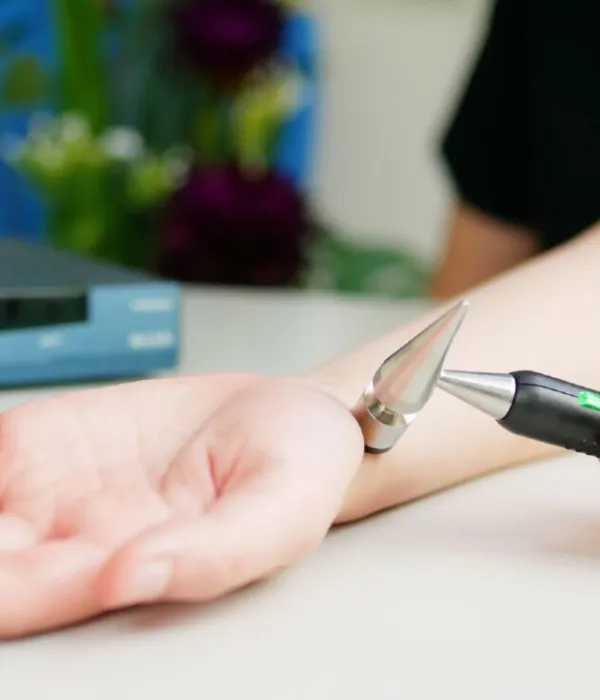
The Senergy M.E.A.D. is a diagnostic instrument, not a treatment. A practitioner places a probe at acupuncture points along the body's twelve primary meridians and measures the galvanic skin response at each location. Patterns of high or low conductance reveal which systems are under stress and which are functioning in balance.
Those readings then guide what happens next. The findings tell the practitioner exactly which frequencies, sites, and protocols to use in a follow-on BioModulator or microcurrent session. Re-scanning after treatment shows whether the protocol moved the system in the intended direction. Assessment, treatment, re-assessment.
"The M.E.A.D. is the difference between guessing and routing. It tells us where the body is asking for support before we touch a single setting."
Danielle Palmer, Natalie Sakamoto, & Christina Monet —
M.E.A.D. Practitioners, The Ascent Collaborative
client reports
What clients report from regular assessments.
A personalized treatment map
Sessions move from generic protocol to a plan built around what your meridian profile is actually showing.
Earlier visibility on stress patterns
Energetic imbalances often show up in meridian readings before they show up as symptoms clients can name.
A measurable baseline
The scan establishes a starting point so progress over a protocol cycle is something you can see, not infer.
Clearer answers in complex cases
When symptoms are diffuse or overlapping, meridian patterns help narrow which systems to support first.
Smarter device pairings
Readings inform which technologies in the Ascent stack are likely to make the biggest difference for this client.
A non-invasive starting point
No needles, no draws, no discomfort. A surface probe at acupuncture points and a clear visual map at the end.
Client outcomes vary. M.E.A.D. is a wellness assessment tool informed by Traditional Oriental Medicine and bioenergetic principles. It is not intended to diagnose, treat, cure, or prevent any disease.
Who It's For
M.E.A.D. is built for people who want a plan, not a guess.
The assessment is most valuable for clients whose situation is complex, whose protocol needs personalization, or who want a measurable baseline before they begin.
BioModulator clients
Anyone starting a BioModulator or microcurrent protocol. The M.E.A.D. is what tells the practitioner where to direct the frequencies.
Complex or chronic cases
Clients with overlapping symptoms who need the system mapped before deciding which area to support first.
Longevity & prevention
People who want visibility into stress and energetic patterns now, while they are still subclinical and easier to address.
Progress tracking
Clients who want their wellness work measured. Re-scanning over time shows whether the protocol is moving the system.
What a Session Feels Like
Your first visit, step by step.
01
Orientation & intake
Brief conversation about your health history, current symptoms, goals, and any technologies you have used. This frames what the practitioner is looking for in the scan.
02
Meridian scan
The practitioner places a probe at acupuncture points along your meridians, recording conductance values. The full reading takes roughly 20 to 30 minutes.
03
Review & protocol
Your map is reviewed with you on screen. The practitioner explains what the patterns suggest and which Ascent technologies and protocols are the best next step.
04
Treatment & re-assessment
BioModulator or microcurrent treatment proceeds from the findings. Many clients re-scan after a series of sessions to measure shift.
The Science
Skin conductance, meridian points. That's the mechanism.
The M.E.A.D. operates in the tradition of Electroacupuncture According to Voll (EAV), a method developed in the 1950s that measures electrodermal activity at specific acupuncture points. Skin at these points has measurably different electrical conductance than surrounding tissue, and that conductance shifts in response to physiological state, stress, hydration, and autonomic regulation.
The peer-reviewed evidence base for electrodermal activity as a marker of stress and autonomic tone is established. Evidence for EAV-style point-by-point meridian interpretation is more limited and continues to develop. At Ascent we frame the M.E.A.D. honestly: as a practitioner assessment tool informed by Traditional Chinese Medicine and bioenergetic principles, used to guide treatment decisions and track change over time. Evidence-informed and experience-tested.
Session basics at a glance
Length
30–45 minutes
Frequency
Baseline, then re-scan every 4–8 weeks
Contraindications
Active pacemakers, pregnancy (consult practitioner)
Position
Seated or reclined
What Happens
Practitioner-applied probe at meridian points; no needles, no discomfort
Studies & Research
The evidence behind the M.E.A.D. process.
The Senergy M.E.A.D. as a specific device does not have independent peer-reviewed randomized trials in indexed journals. What does have a developing evidence base is the underlying science: electrodermal activity as a marker of autonomic state, and EAV-style point measurement as a feasibility-tested assessment method. The studies below represent that modality-level research. The BioTekna platform (a related electrodermal device also distributed by Senergy) has one multi-center clinical validation.
BRAND-ADJACENT RESEARCH
PMC
Clinical Validation of Non-Invasive Electrodermal Biofeedback Device for Reducing Chronic Pain and Systemic Inflammation (n=1,015, multi-center)
A multi-center clinical validation of the BioTekna electrodermal platform (carried by Senergy alongside the M.E.A.D.) in over 1,000 patients reported reductions in chronic pain and markers of systemic inflammation, supporting the broader clinical utility of electrodermal biofeedback assessment.
MODALITY RESEARCH
PubMed
Electrodermal Activity and Stress Assessment
A foundational review of electrodermal activity as a quantitative measure of sympathetic nervous system arousal. Establishes EDA as a peer-reviewed window into autonomic state, the same physiological signal that underlies the M.E.A.D. and EAV-based assessment.
Modality Research
OBM Integrative and Complementary Medicine
Electrodermal Activity on Acupuncture Points After Exercise: EAV Feasibility Study
A feasibility study specifically measuring electrodermal activity at acupuncture meridian points, directly testing the EAV (Electroacupuncture According to Voll) framework on which the M.E.A.D. is built. Demonstrates measurable, reproducible signal changes at meridian points following physiological challenge.
Modality Research
Acta Neuropsychiatrica
Wearables Measuring Electrodermal Activity for Stress in Care: Scoping Review
A scoping review of electrodermal activity sensors used in clinical and care settings to monitor stress, autonomic regulation, and recovery. Reinforces the role of EDA-based measurement as an established assessment signal across clinical contexts.
Galvanic skin response
The body's skin conductance changes with sympathetic nervous system activity. M.E.A.D. measures these shifts at specific anatomical points to read autonomic state non-invasively.
Meridian mapping
Acupuncture meridians describe pathways the body uses to regulate energy and circulation. Measuring conductance along these pathways gives the practitioner a system-level view, not just a symptom-level one.
Treatment routing
The findings translate directly into protocol decisions: which BioModulator frequencies to deliver, which sites to treat, and which Ascent technologies to layer for the best outcome.
M.E.A.D. is a practitioner assessment tool informed by Traditional Oriental Medicine and bioenergetic principles. It is not a diagnostic medical device.
Frequently Asked
M.E.A.D. Analysis, answered.
What is the M.E.A.D. and what does it measure?
M.E.A.D. stands for Meridian Energy Analysis Device, a Senergy assessment tool that measures galvanic skin resistance at acupuncture meridian points. The result is a map of which systems show signs of stress and which are in balance, used to personalize treatment.
How is the M.E.A.D. different from the Qest4?
Both use electrodermal screening, but they are used differently. Qest4 is a broad bioenergetic stress screening used as a general wellness scan. M.E.A.D. is specifically used to map meridian energy patterns and route BioModulator or microcurrent treatment, before and after sessions, to measure shift.
What does a M.E.A.D. session feel like?
Comfortable and non-invasive. You sit or recline while the practitioner places a small probe at acupuncture points on your hands, feet, and other meridian locations. There are no needles, no current that you would feel, and no discomfort. The full reading takes 20 to 30 minutes.
How long does a full assessment take?
A first-visit M.E.A.D. session typically runs 30 to 45 minutes, including intake conversation, the scan itself, and review of the meridian map with your practitioner. Follow-up re-scans are usually shorter.
How often should I be re-assessed?
For most clients on an active protocol, a re-scan every four to eight weeks is enough to see meaningful shift. Practitioners may recommend a different cadence depending on your goals and what your scan is showing.
Who should not use the M.E.A.D.?
Anyone with an active pacemaker or implanted electrical device should consult their physician before assessment. Pregnant clients should also consult their practitioner. The M.E.A.D. is a wellness assessment, not a diagnostic tool, and is not appropriate as a substitute for medical evaluation.
Does the M.E.A.D. diagnose disease?
No. The M.E.A.D. is a practitioner assessment tool informed by Traditional Oriental Medicine and bioenergetic principles. It is not a diagnostic medical device, and its readings should not be used in place of medical diagnosis or treatment.
Is the M.E.A.D. usually paired with other technologies at Ascent?
Yes. The M.E.A.D. is most often used in combination with the BioModulator and microcurrent treatment, because the meridian readings tell the practitioner exactly which frequencies and treatment sites are likely to produce the most change.
begin your ascent
Experience M.E.A.D. at
The Ascent Collaborative.
One of the few centers in Orange County operating the Senergy M.E.A.D. as a working part of a 22-technology stack. Used to route treatment with measurable precision, under expert guidance since 2010.
Or call (949) 781-5769 · 150 Paularino Ave, Suite D-170, Costa Mesa, CA 92626

THE ASCENT COLLAB
Human optimization and regenerative wellness. Costa Mesa, Orange County, CA
Featured in Men's Journal as "The Gym of the Future"
Company


© 2026 The Ascent Collaborative. All rights reserved. | Privacy Policy
150 Paularino Ave, Suite D-170, Costa Mesa, CA 92626 | (949) 781-5769